About
Solutions
Projects
Resources
Support
Audiences today arrive at museums with the expectations shaped by smartphones, streaming and games. They want exhibitions that respond to them, invite them in and let them explore content at their own pace. At the same time, museum teams need solutions that respect curatorial decisions and run reliably in permanent, high-traffic environments.
Scape X® is one of the most powerful answers to this challenge. It brings together patented object-recognition technology and professional 4K multi-touch hardware to seamlessly connect physical objects and digital content. The result: interactive exhibitions and knowledge spaces that feel natural to visitors of all ages and stand out from conventional media stations.

If you are familiar with our patented technology, feel free to skip this paragraph; otherwise, we invite you to sit back, relax, and enjoy a quick but necessary intro about our Object Recognition.
Scape X® is a versatile human–machine interface that turns objects into intuitive, tangible controls on large-format multi-touch displays. Instead of navigating complex menus, visitors simply place specially designed Scape X® Objects on the surface to open themes, filter content or trigger specific perspectives. The hardware behind it consists of premium PCAP multi-touch displays with high-resolution 4K panels, certified for intensive horizontal 24/7 operation.
This is what sets Scape X® apart from a “standard” touch table: the engine can distinguish up to 24 unique object IDs as standard, with custom projects reaching up to 100 unique IDs in a single exhibition application (like the one developed by our partner PONG.Li for the 200 years of the Karlsruhe Institute of Technology) while supporting virtually unlimited simultaneous touch points. Content is directly linked to physical objects, so visitors can literally “grasp” complex topics—whether they are exploring archival material, zooming into historical maps or navigating interactive simulations, as realised for example at the State Archives of Baden-Württemberg and the German Museum of Technology in Berlin. In many museums, such as the Icelandic Museum of Natural History, Scape X® installations have been running for years with stable operation and without reported object theft, a crucial factor for busy exhibition spaces.

Scape X® adapts to a wide range of exhibition concepts and curatorial strategies. In archive-focused environments, Scape X® tables turn digitised collections, documents and maps into a living, dynamic interface. At the State Archives of Baden-Württemberg, for example, visitors can place thematic markers to filter content, use ring-shaped objects to zoom into tiny details and compare multiple artefacts side by side—without needing any prior digital experience.
In museums dealing with technology, science or complex systems, Scape X® enables deep-dive discovery. Objects can be used to switch between timelines, reveal cross-sections, access 3D models or activate explanatory layers. This supports both guided tours and self-directed exploration, and helps visitors build their own path through the content. In history-related exhibitions, like the DDR Museum in Berlin, Scape X® makes abstract narratives tangible: everyday life, political structures or social change become interactive stories that can be placed, moved and combined directly on the table.
Scape X® also shines in collaborative and game-based scenarios. At Futurium in Berlin, for example, a multiplayer exhibit on the circular economy uses physical tokens and an animated cityscape to let groups experiment with strategies like Reduce, Repair, Re-Use, Refurbish and Recycle. A real-time model calculates the impact of visitors’ decisions, turning complex systems into a shared, playful learning experience. Across these examples, one technology supports very different modes of engagement: open-ended exploration, guided storytelling and highly interactive, multi-user experiences.
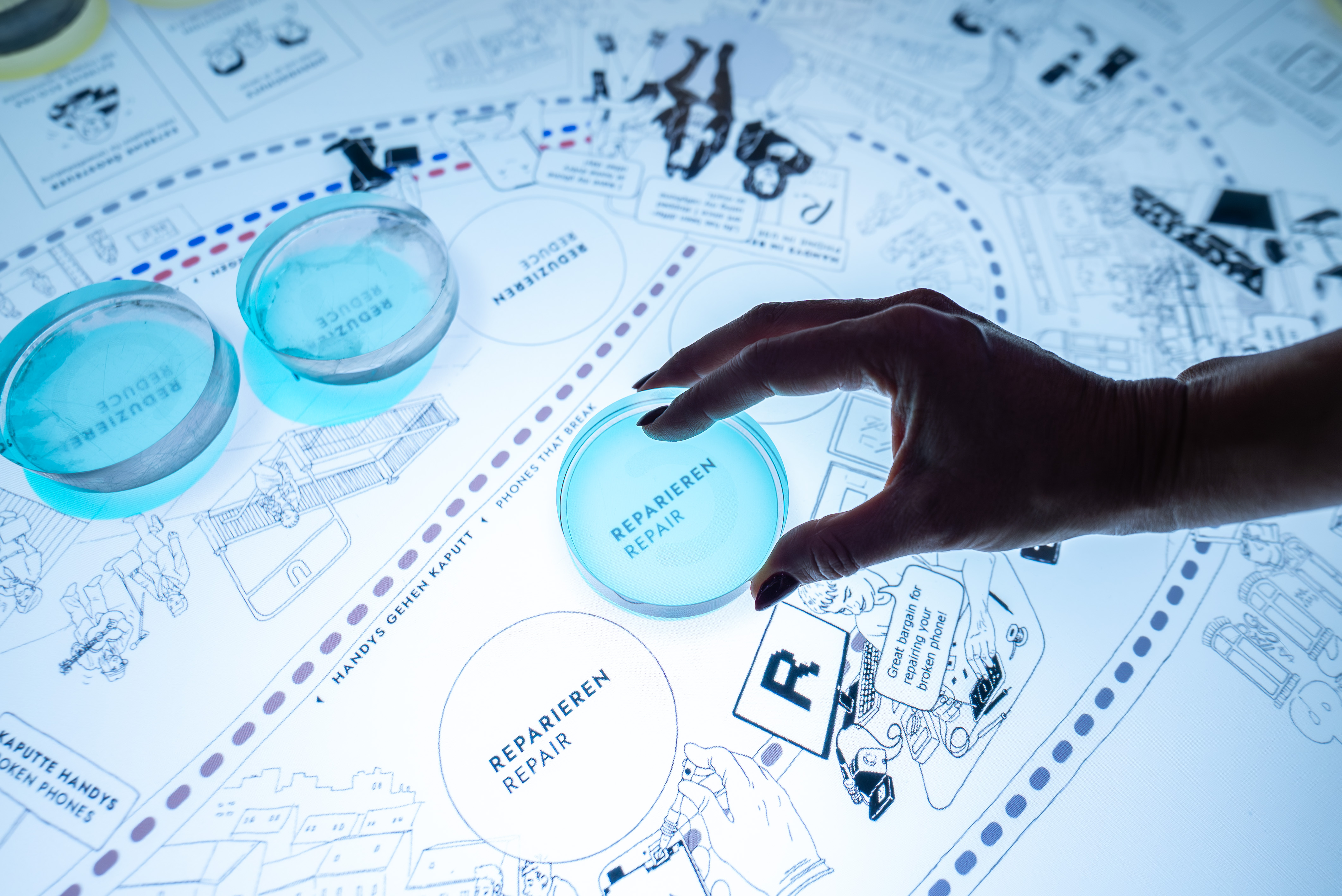
Designing interfaces that work for school groups, families, experts and seniors alike is a core challenge for museums. Scape X® tackles this with tangible objects and simple, self-explanatory gestures: place an object to open a topic, move it to navigate, rotate it to change perspective, use a magnifying ring to dive into high-resolution details. The threshold to participation is low, even for visitors who are not used to digital installations.
At the same time, Scape X® is built for genuine multi-user interaction. Large surfaces, high touch capacity and multiple parallel objects encourage people to gather around the table, discuss, experiment and learn together. This collaborative quality is particularly valuable for workshops, guided tours and school programmes. The hardware is engineered for continuous operation, with robust construction and monitoring features that keep performance stable even in highly frequented environments. Combined with secure and durable object designs, this ensures that the installations remain reliable, safe and enjoyable over many years.

Scape X® gives museums and partners freedom in how they develop their applications. Many institutions work directly with Interactive Scape’s software team, which creates tailor-made experiences aligned with the specific collection, storyline and exhibition design. Others collaborate with international partners who specialise in museum, brand and educational projects and build on the Scape X® platform.
For museums with their own digital teams or preferred agencies, Scape X® integrates smoothly into existing workflows via TUIO. Developers can use engines and frameworks such as Unity, vvvv or Ventuz and receive object and touch data from Scape X® as a standardized input. This makes it possible to prototype quickly, iterate concepts and deliver highly customised applications—without changing the underlying hardware or compromising on reliability.
Scape X® Surfaces takes the same object-recognition technology beyond classic screens onto premium material surfaces. PCAP sensors, Corian® material, and precise projection mapping combine to create sleek, non-display interaction zones that blend elegantly into museum furniture and architecture. Visitors see a pure, refined surface—and only when they touch it or place an object does the content come to life.
For curators and exhibition designers, this opens up new ways to integrate media without filling the space with monitors. Content appears exactly where it is needed: on tables, counters, showcases or architectural elements. The interaction is as precise and responsive as on a classic Scape X® table, but the overall impression is more sculptural and immersive. Scape X® Surfaces delivers a futuristic, unique and memorable interaction that feels like a natural part of the exhibition, not an add-on.

Every museum faces different questions: How can archives become more accessible? How can complex systems be made understandable? How can visitors be encouraged to experiment without being overwhelmed? Scape X® offers a flexible toolkit to tackle these challenges, but its full potential unfolds when it is tailored to a specific collection, space and audience.
Interactive Scape invites museums, exhibition designers and partners to explore their own Scape X® scenarios together. Whether you are planning a compact pilot setup, a multi-station gallery or a large-scale, networked exhibition, the team supports you with consultation, demos and project development.
Book a Demo: www.interactive-scape.com/book-your-live-demo
Reach out to the Team: contact@interactive-scape.com
Check out our Use Case Brochure: Download here
© 2026 interactive scape GmbH
Wilhelmine-Gemberg-Weg 6, 10179 Berlin
contact@interactive-scape.com
+49 30 69 80 94 - 100