About
Solutions
Projects
Resources
Support
Interactive Scape is always experimenting, researching, and challenging the status quo. While pushing the boundaries of what’s possible in terms of form factors with the Scape X® Certification for third-party PCAP hardware, we asked ourselves a simple question: what if Scape X® could go even beyond the multitouch surface, beyond traditional displays?
Together with some key partners, we built a prototype that takes Scape X® into a new dimension: transforming a solid Corian® table into a fully interactive, projection-mapped surface. In its very first prototype form, this setup quickly became one of the greatest showstoppers at Integrated Systems Europe, where it debuted in 2026.
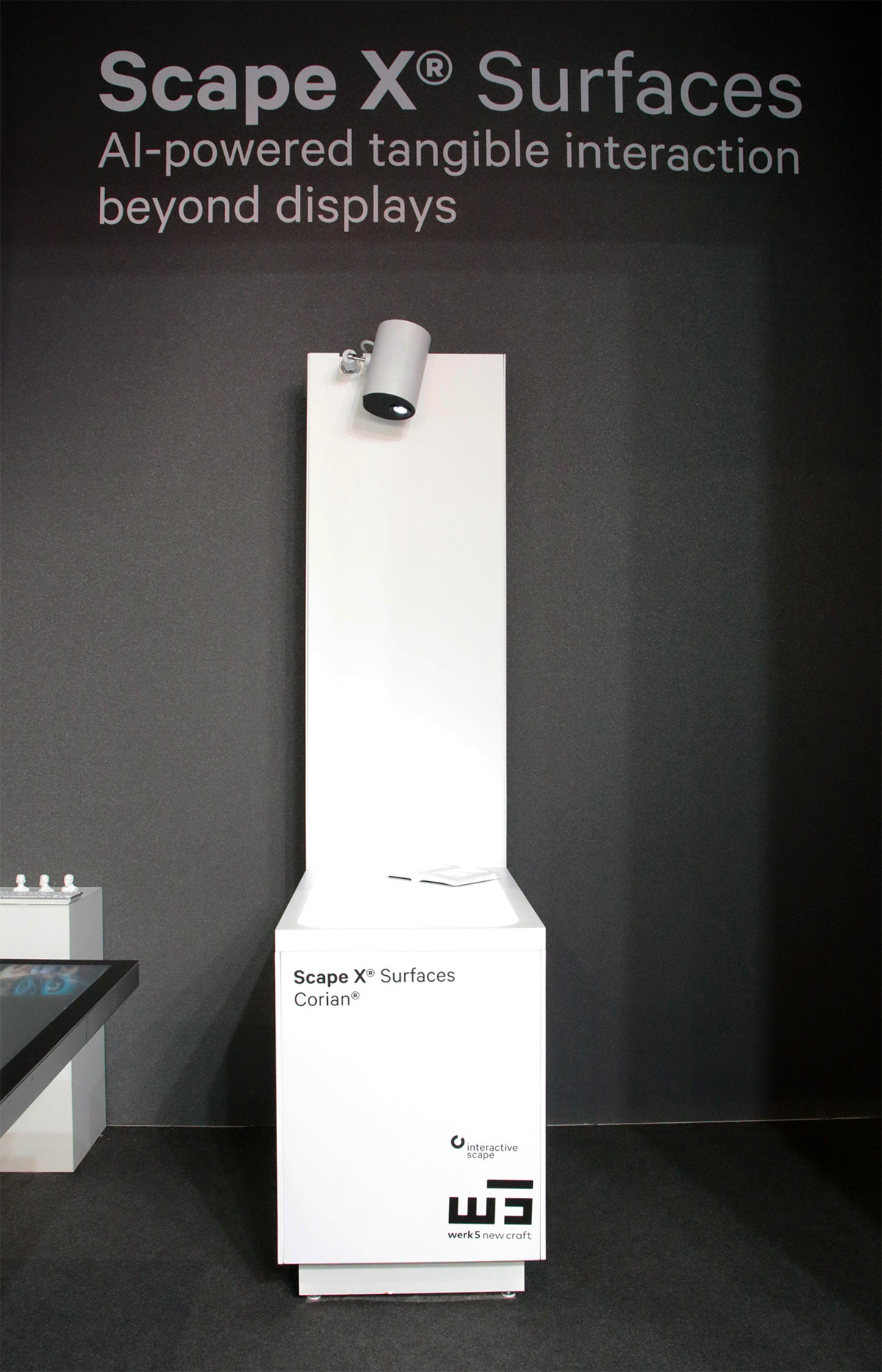
Hardware-wise, Scape X® Surfaces is the result of a tightly integrated stack of partners and technologies working together. The German company werk5 GmbH designed a premium table made of solid Corian®, providing a robust, design-driven foundation that feels at home in high-end museum, showroom, and experience center environments.
Just below the Corian® surface, a Displax PCAP foil turns the table into a precise multitouch sensor, which is then connected to the Scape X® Module (our unique AI-brain) and a projector. When a physical object (in this case we used the Scape X® Stickers) is placed on the surface, Scape X® recognizes it and triggers the corresponding digital content. That content is then projection-mapped directly onto the Corian® as well as the object, so the table itself becomes an interactive playground where physical objects and digital information naturally align.
The result is a seamless fusion of tangible interaction, PCAP touch, and projection mapping that propels Scape X® beyond traditional touchscreen displays into a new realm of spatial, object-based experiences. It delivers fast, reliable tracking of motion, objects, multitouch, and gestures — all on a surface that appears as an ordinary table until brought to life by placing an object.
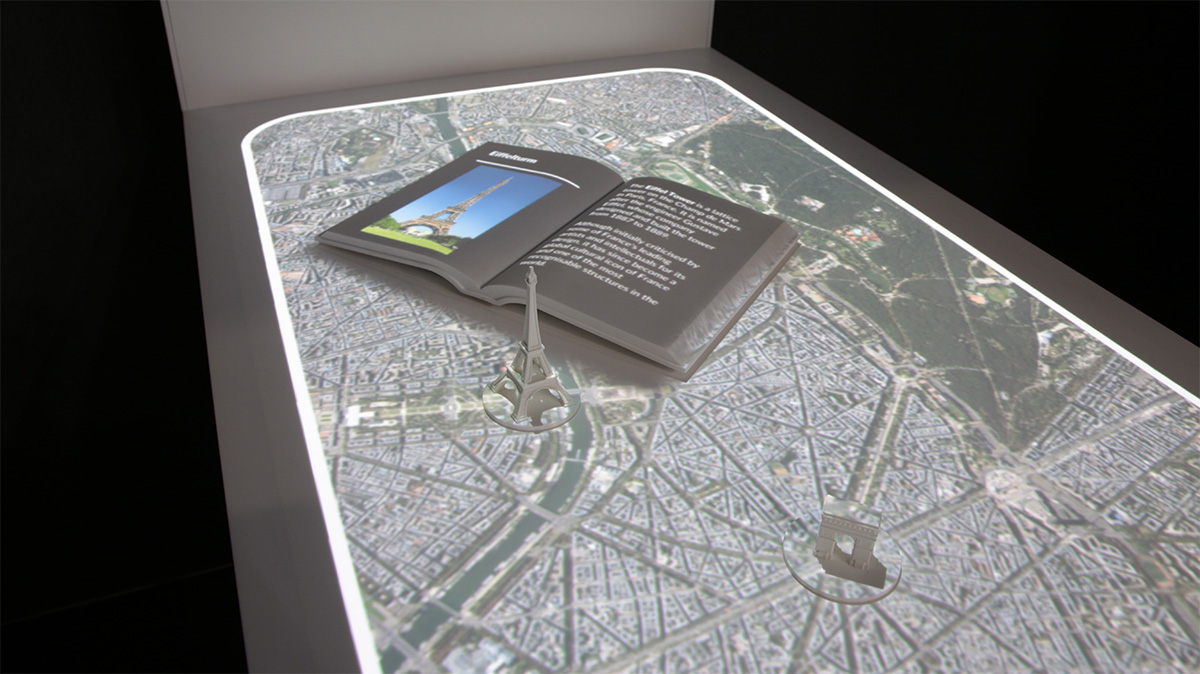
For the first prototype application, we created an interactive Paris experience to showcase how physical objects can control rich, geo-referenced content. The objects are a book, a model of the Eiffel Tower, and a model of the Arc de Triomphe.
Placing either the Eiffel Tower or the Arc de Triomphe on the Corian® surface triggers a large Paris map projection on the table, while related content is projected onto the book. The book can be freely moved around on the surface, and the projected content follows it in real time, staying perfectly aligned.
If both attractions are placed on the table, the system reacts by adapting the map view: move the objects closer together and the map zooms in; move them further apart and it zooms out, always maintaining the correct geo-referenced positions. This creates an intuitive, playful way to explore a city and its stories – ideal for museums, visitor centers, or tourism-focused experience spaces.
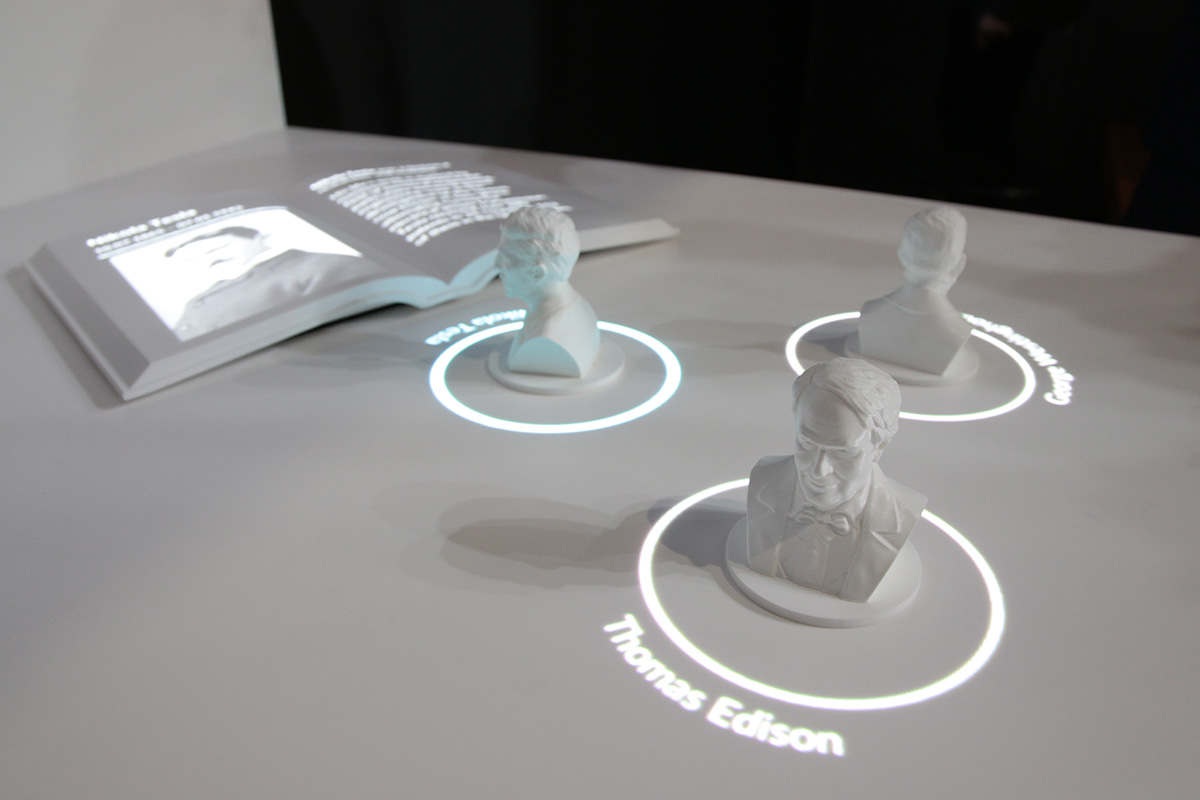
In the second scenario, three busts of famous scientists – Nikola Tesla, Thomas Edison, and George Westinghouse – become interactive knowledge objects thanks to Scape X®. Placing one of the busts on the surface instantly reveals the scientist’s name and key information projected onto the book, which acts as a dynamic information panel.
When more than one bust is placed on the table at the same time, the system uses proximity logic: the book always shows information about the scientist whose bust is closest to it. This allows visitors to naturally discover, compare, and switch between personalities simply by moving the objects around. It is a powerful example of how museums and exhibitions can evolve static displays into living, responsive learning experiences.
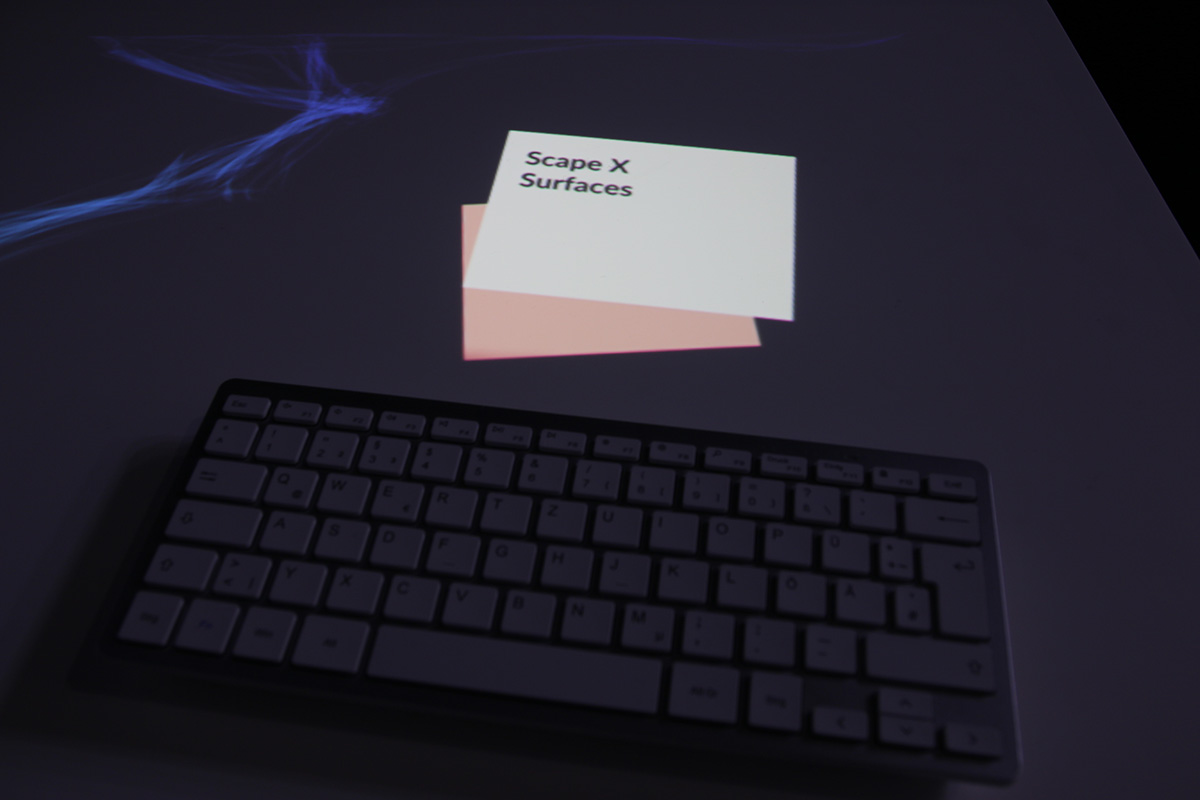
The third use case demonstrates that even a familiar everyday device can become an object in the Scape X® ecosystem. Here, a wireless keyboard itself acts as the tangible trigger. When placed on the surface, a digital sticky note appears, projected onto the Corian®.
Users can type notes, move the projected note around, and resize it to fit their needs. Lifting the keyboard makes the note disappear from the surface; placing the keyboard back brings the same note back, allowing the session to continue right where it left off. This creates a simple but powerful pattern for collaboration spaces, workshops, and decision-making environments: physical tools that summon and control digital layers only when and where they are needed.
Scape X® Surfaces shows that tangible multitouch interaction doesn’t have to be limited to flat screens. By combining Scape X® object recognition with third-party PCAP hardware, premium materials like Corian®, and precise projection mapping, we can turn non-traditional surfaces into a stage for multi-user, object-driven storytelling and collaboration.
This kind of setup is particularly relevant for:
With Scape X® Surfaces, physical objects become the keys to digital worlds, and surfaces transform into active participants in the story. If you’re exploring new ways to merge the physical and digital in your next exhibit, installation, or collaboration space, we’d be happy to talk.
For more information or to discuss a project, please contact: sales@interactive-scape.com
© 2026 interactive scape GmbH
Wilhelmine-Gemberg-Weg 6, 10179 Berlin
contact@interactive-scape.com
+49 30 69 80 94 - 100